
The notion of “traditional” varies from to person to person. Of late, even seasoned performers have been questioning the traditional structure of a concert. It is not uncommon to hear Varnams during the middle of the concert or a Geetham as a main piece. In a true sense of artistic freedom, any form of expression is acceptable as long as it reaches the audience. People should be open to “controlled experimentation” once in a while.
Recently I had an opportunity to participate in a Karnatic music concert presented in a Western choir format. The event was curated by Brisbane’s music teacher, Smt Susmita Ravi.
The program was a great success, both in terms of audience turn out and the participation of the students.
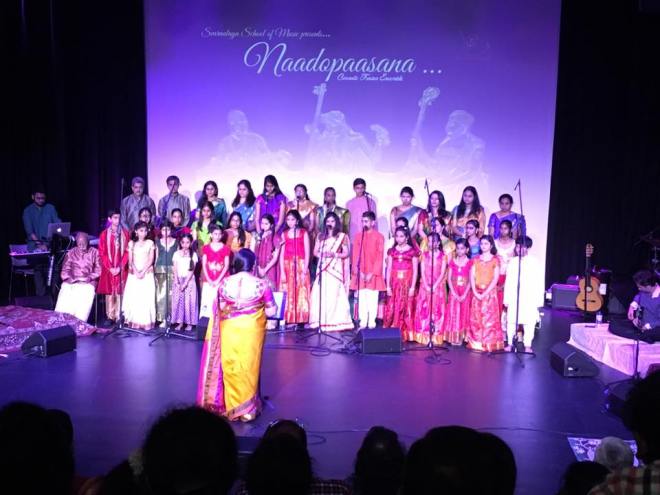
The concert had 33 vocalists on stage supported by 7 instrumentalists. Among the vocalists a few were mature age students – the rest were children. It is, indeed a commendable task to motivate a wide range of participants to sing. It was obvious that the kids were genuinely interested in performing – they are not merely standing there to fulfil their parent’s desires. It was a great sight, the student’s love and admiration towards their music teacher and their enjoyment in their performance.
The songs were predominantly in hamsadwani, mohanam and shankarabharanam. Except for a short piece in Shanmugapriya, the rest of the ragas were “suddha madhyamam” based. Audience did not seem to mind the repetition of ragas and enjoyed the diversity of compositions and the spirit of concert!
This concert also enabled everyone to appreciate the fact that our known classical composers like Thyagaraja Swamy, Muthuswami Deekshitar created music in western tunes too.
The concert included the following compositions:
- Opening song in Hamsadvani.
- Mohanam Varnam
- A tamil raga malika – shanmugapriya, vasanta, mohanam, sindu bhairavi
- Bho Sambho – Revathi
- Pankajamukha – Deekshitar composition- Shankarabaranam
- Vara Veena (geetham)
- Vande Meenakshi – Deekshitar composition- Shankarabaranam
- Bala Tripura Sundari – Shankarabaranam
- Vara Leela Gana – Thyagaraja’s composition – Shankarabaranam
- Madurai Mani Iyer’s Western Notes (Shankarabaranam)
- Thaye Yashodha – Todi – western fusion
- Dhanasree Thillana
- “I still call Australia Home ” – Qantas choir
- Vande Maataram
The vocalists were supported by a group of 7 instrumentalists. Including two violins – one to play in a western style and one for karnatic was quite an interesting experiment. Brruuntha Sundaram played the western violin and Ashwin Vaidhyanathan played Karnatic style Violin. They brought out the desired contrasting effect very efficiently.
Having Bart Stenhouse on the guitar instilled Hindustani touch to the overall flavour. Bart’s handling of the ragas marked by the traditional “meend” and “gamak” and was authentic.
Another “wow” factor was the touch of Santoor and other instruments provided by Parth Raval on the key board. Unlike the typical keyboard sounds, his keyboard notes sounded original. Later Parth explained that he samples real sound clips and adds to his MIDI library. In other words, the santoor sound we heard was a real one and not a synthetic version. Great work, Parth!
The percussion support was provided by Kush Sami on the drums and Kiran Varma on the mridhangam. Kush is a disciple of legendary Tabla player Pt Zakir Hussain. Though Kush played drums, (instead of tabla) his rhythm lifted the performance.
Kiran had his training from the well known Mridangam vidwan Sri Melakaveri Balaji. Kiran’s measured theermanams (traditional ending passages) provided the necessary Karnatic touch to the rendition.
I gave the flute support for concert. Mostly I played in the karnatic flute, 5.5 pitch (G#). It is the type of the flute the legendary Mali used to play. Modern day concert flautists prefer lower pitched flutes. However, it is not uncommon to have high pitched flutes in Bharatanatyam/Kuchipudi performances. For the karnatic songs, I gave the melodic support. While accompanying the western style numbers, I switched to the bansuri to blend well with the music.
This event was very well conceived and executed. Few take away points:
- engaging and connecting with students at more than one level, is an important attribute of a successful music teacher
- kids should enjoy the music and stage performances at whatever level they are performing. They can always master the techniques at a later date when they are ready for it.
- Engaging the community in the journey is essential. Each member should feel they have contributed to the success of the event.
- Stepping outside comfort zone is important to push the boundaries. Do not be afraid to experiment!
Here is the glimpse of the grand finale
Organizing and executing an event at this level, while training the students is no mean task. A very well deserving applause for Smt Sushmita Ravi for undertaking this task. We look forward to have more events like this.

 Sunadham